Disclosure and kayfabe
Why Disclosure Day starts with wrestling.
Kayfabe is a sacred pact between performers and their audience. It means that they both agree to treat play acting as real.
It says: We will all suspend our disbelief so that the show and its actors can unveil dramatic twists and turns.
The agreement is necessary even when the action is as real as it gets. The Undertaker once choke-slammed Mick Foley’s Mankind off of a 30-foot cage onto a table covered in metal tacks.

“Good God, almighty; that killed him! As God as my witness, he is broken in half!” - Jim Ross
We can watch that and say that the show is pretend. Yet for Mick and the painkillers he’d need, it was very real. Anyone who saw him lying in a pool of his own blood didn’t scoff and say: “That’s so fake!”
But we knew it was all a spectacle, that the drama was a fabrication, and that these men were masters of their craft with profound respect for one another. The wrestlers and the audience never let the illusion slip, and the legend secured itself in time.
In the ring
In wrestling, where the term kayfabe originated, the physicality is real. Embellished, yes, and still an exchange of painful force. But the characters, their key dance steps, the set, and the setting are all made up, and the story arcs have predetermined outcomes.
There is the good guy, the babyface who we all root for, destined for the title belt and the merchandising deals. Then there is the heel, our villain, the bad guy who makes us want to spit, also in line for great merchandising deals.

“OHH YEAHH BROTHERRR!” - Macho Man Randy Savage, Heel of Legend
Steven Spielberg’s new film, Disclosure Day, begins with wrestling. Before we meet our central character, the audience witnesses two combatants battling within the square circle.
At one point, the audience becomes the camera. We see the action, SLAM, and we experience it as if we are the wrestler.
But in the context of a UFO disclosure story, why would the audience become the wrestler, the performer?
For what purpose does Spielberg change our perspective to the first person as the actors in the film look down at us?
This is a deliberate choice. The actors, or rather their characters, represent disclosure. They are the information. They are the truth. And in this film, the truth is that aliens are among us and influence our behaviour and development. But that’s not the truth that Spielberg is poking at.
It is instead a subtle confession from one of the more talented storytellers of our time. And it’s apt given this is his sixth film which uses extraterrestrials or the other as a narrative device.

Raking in the gold.
Kayfabe, the real disclosure
Mr. Spielberg put us in the ring because in life, we are the performers. We all pretend that the experience that we’re having is real. But many contemplative traditions suggest that beneath mundane consciousness, we are all secretly aware of the true nature of our reality.
What is our true nature? Is it that aliens sit in the background and subtly pull all of our strings? No, that is far too simple. It is something much more strange and fundamental to mind and life.
Jacques Vallée in his summary work Passport to Magonia frames the alien phenomenon as a persistent yet fluid blip within consensus reality.
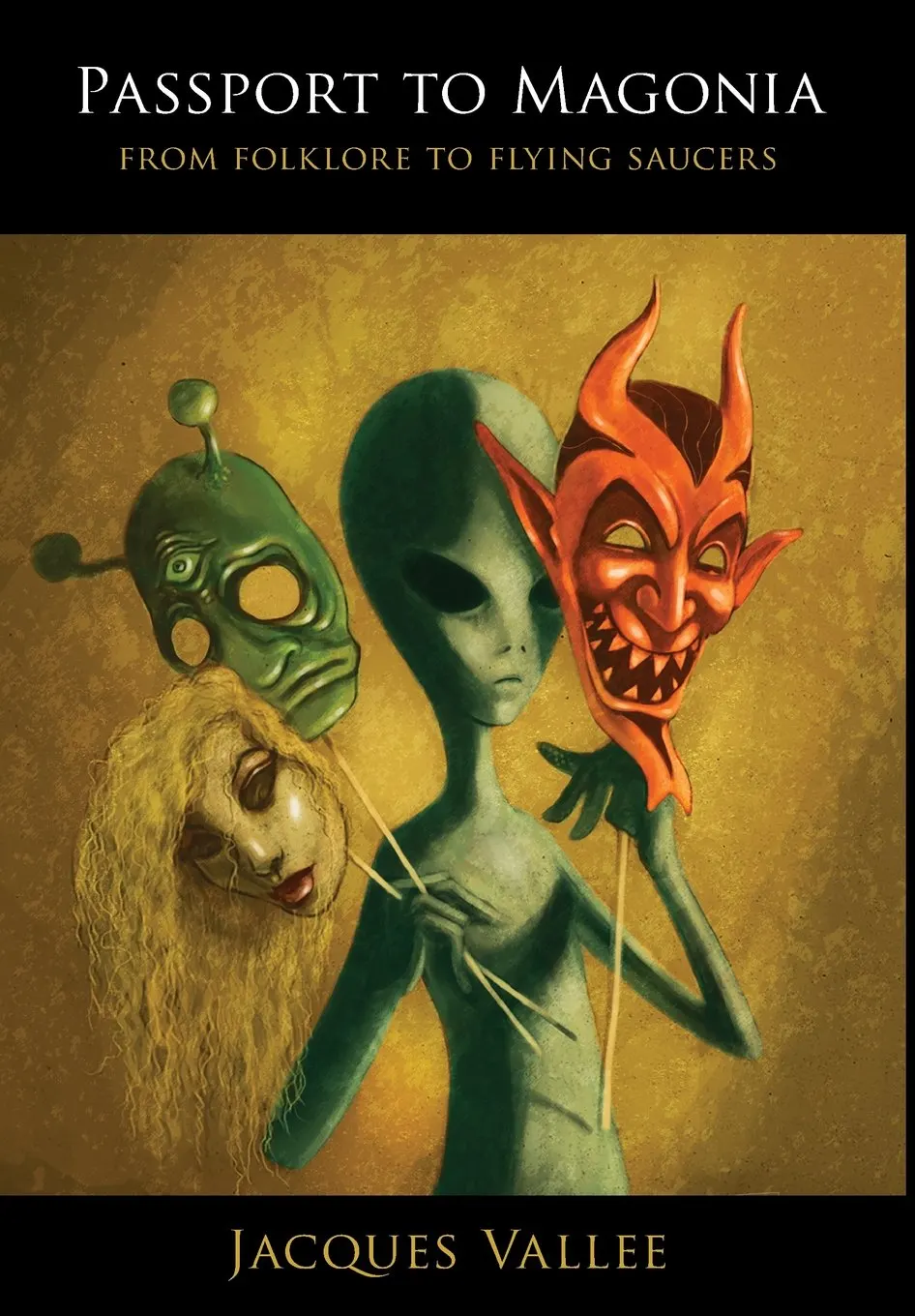
“Hmm, which mask today?” - Nameless, Timeless Other
He considers that humanity may have been interacting with the same class of ‘other’ all along, while each age describes it using its own symbolic vocabulary:
“The symbolic display seen by the abductees is identical to the type of initiation ritual or astral voyage that is imbedded in the occult traditions of every culture…the structure of abduction stories is identical to that of occult initiation rituals…the UFO beings of today belong to the same class of manifestation as the occult entities that were described in centuries past” - Jacques Vallee
First it was angels and faeries and pixies, then it became tall whites and grays; flying wheels became space-ships. There’s always been a shadow on the edge of the periphery that wears many faces and observes, but does not belong.
Yet to isolate and separate this other creates a paradox. If we want to understand it, we must give up the game and remember the circumstances in which we find ourselves. Or we can stay committed to the bit and interpret it as “alien” and in a fashion appropriate for our collective era.
But alien or occult are but two interpretations; there are many others with startling similarity.
Strong potions
When you dabble in something as potent as Ayahuasca, it can flip your understanding of reality… To say the least.
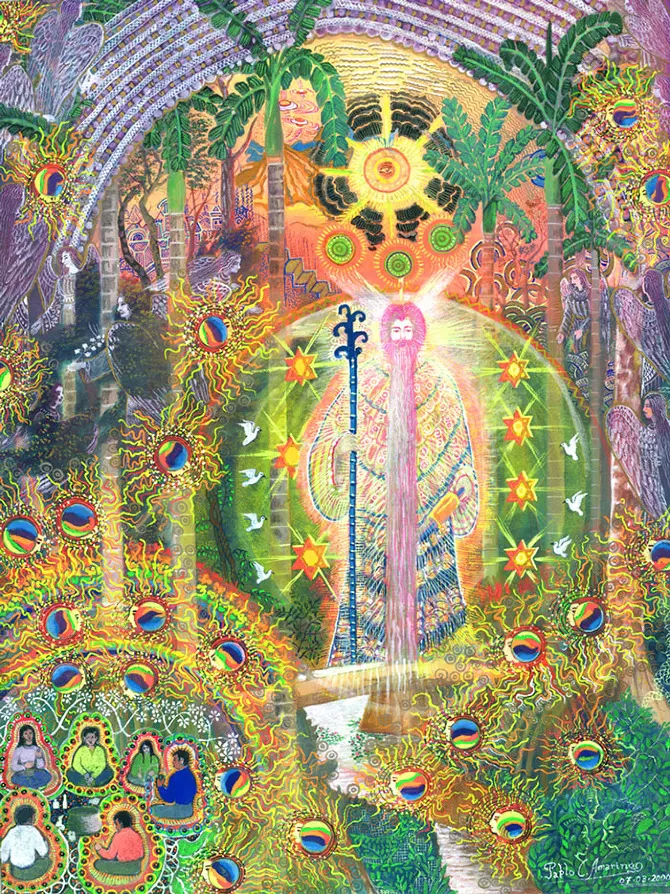
It’s all well and good until “reality” looks as such. By Pablo Amaringo
Among many profound effects, strong psychedelics illuminate mental structures that your mind uses to shape what is real and what is possible.
The post-experience feedback is very consistent:
“Oh my god I can’t believe that’s real.”
And somehow the transcendent feels more real than real.
Even though it is commonplace to meet strange creatures and machine elves, travel through time and space and see and learn things that could not possibly originate from our own past experiences, it feels true.
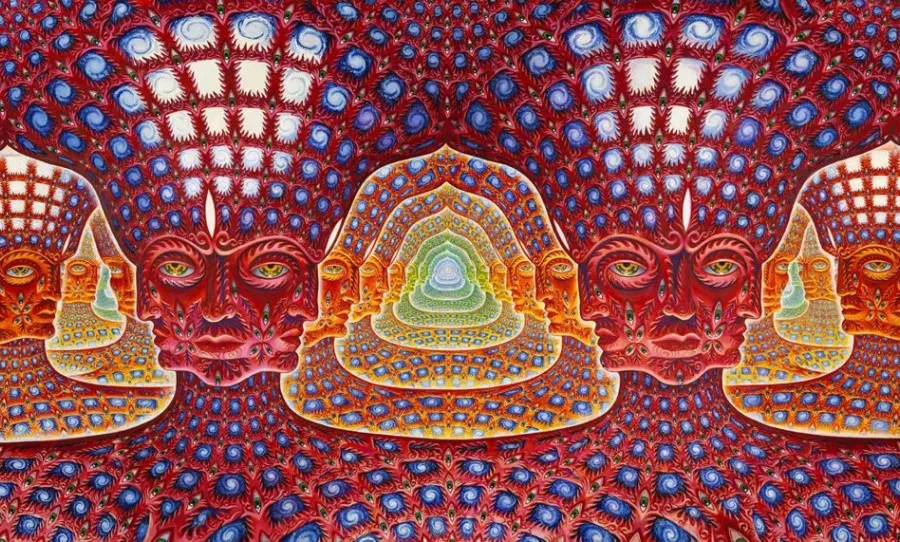
“Well, whatever. We think YOU’RE weird.” - Machine Elves
It’s one thing to understand that you can experience another entity appearing before you, other dimensions, and timelessness. It’s an entirely different thing to experience it.
So we can add a third dimension to Jacques Vallée’s observation. The symbolic display of the phenomenon is shared across alien abductees, occult manifestations, and the psychedelic experience.
We can add a fourth too: the heavily populated divine landscapes that contemplative Eastern traditions map.
Are these one phenomenon, or several wearing similar clothes?
What about the grays, man?
But what about the little aliens? What about the encounters and the ships and the glowing lights and the sentient plasmas?
What of the mantid people and the tall whites and the short hairy things that crop up every now and then? What did those kids really see at that school in Brazil? What did they really find in Varginha?
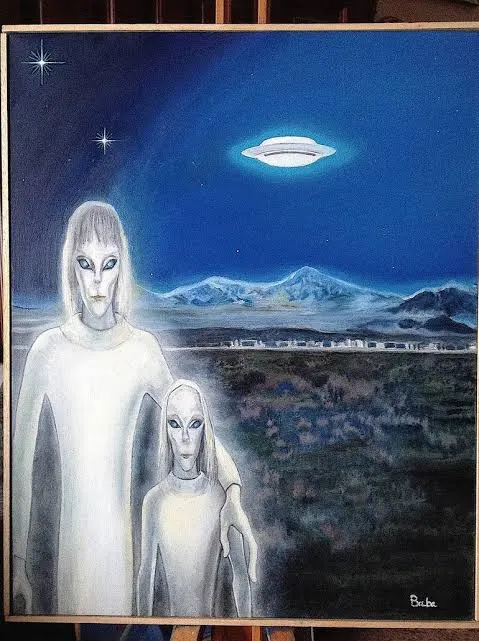
“We won’t take your land, that’s the other tall white people.” By Barbara Barbatelli.
Are all these people lying? Did they really experience this? Are we really not alone?
No, they’re not lying, and yes, they did, in the same way that I have met plants, deities, and other composite abstractions, from the internet to sport, in the noetic realms of meditation and ceremonial Ayahuasca.
Experiencers see and meet aliens as an unfolding of their own reality. But to narrow this mystery into a gnarly contact story is to reduce it too much. This is the case no matter which of the symbolic displays we experience.
The shared, mind-bending realisation is that the separation in our perceptions is itself an appearance: a way the one reality becomes many lives. This is more than the groovy “we’re all one, man” conception. To simply consider yourself an isolated human unit is to embrace the separation. It’s to get in the ring and play.
The truth is, we are alone in the absolute yet never alone. We’re a unity, a singular. And this human game gives us individual experience and all its depth of feeling and flavour. But deep down, we know. We’re but a drop within our own strange ocean.
Ram Dass, along with many mystics, religious thinkers, and writers over the years, has revealed this secret. It resonates most when seekers and experiencers come together.
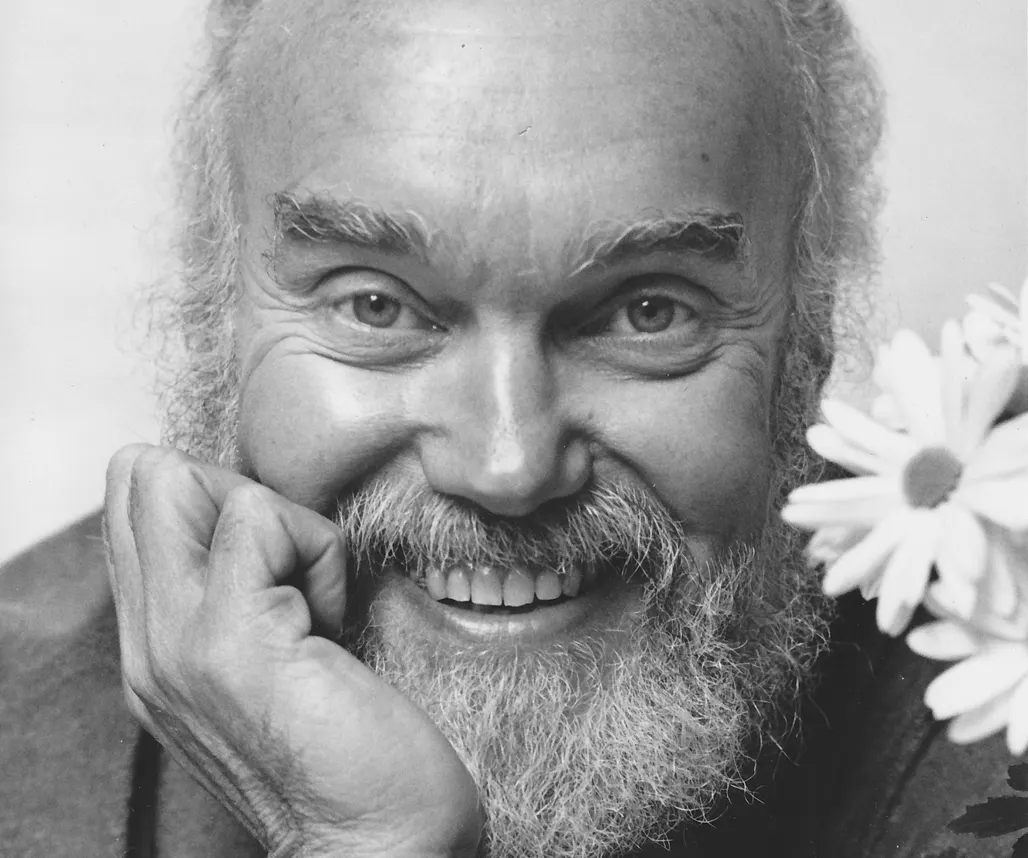
“Though we have lived our life totally involved in the world, we know that we are of the spirit … But when you are in the world you know not of the world. You cannot see the forest for the trees.” – Ram Dass
While in the world, we adhere to kayfabe, and we have a long history of interacting with - even embodying - “alien” beings for collective experience, pleasure and growth.
Nāga please
In our absolute unity, there are an impossible number of permutations of things that one can experience.
For centuries, Buddhist practitioners have penetrated the mind to its deepest possible caverns and found innumerable beings and world systems. It’s a basic tenet of their relative understanding of absolute reality. And their aim is to proliferate the Dharma, the teachings to get off the wheel, to all beings. They even give you a vehicle, meditation, to validate everything for yourself.
Take the Nāgas, an intelligent non-human race of beings that inhabit a reality overlapping our own. They are capable of interacting with humans, sometimes appear in altered form, and often associate with hidden knowledge, water, fertility, and spiritual power.
One such story from the Vinaya of Buddhist teachings includes a Nāga who desires to become a monk to learn how to attain enlightenment. He disguises himself as a human and seeks ordination and teachings from the Buddha.
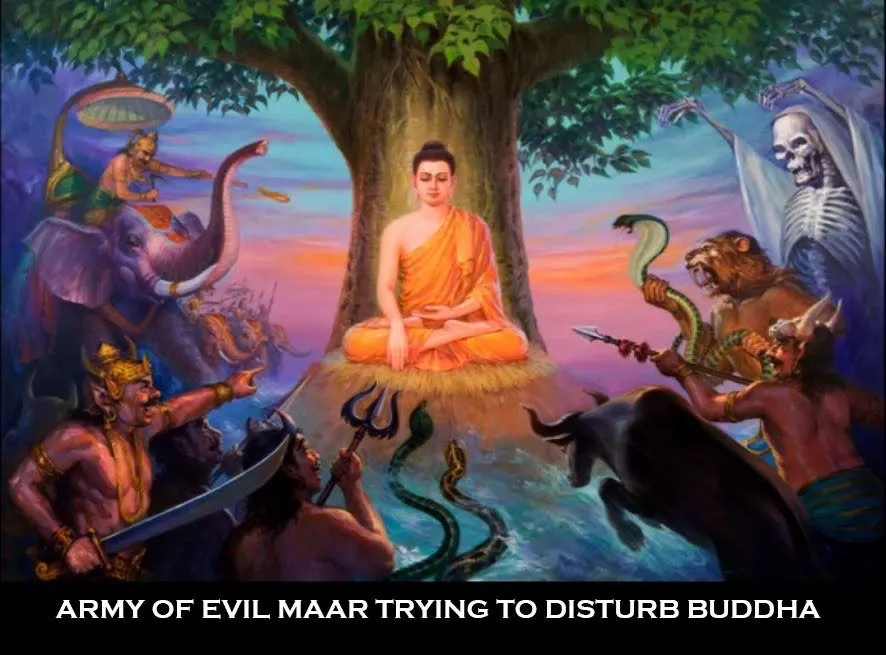
“The many forms of mental forces.”
The Buddha sees through his disguise. He says that to become a monk, he must first take birth as a human, and to do that he must develop more virtue.
To this day, modern Theravāda Buddhist ordination ceremonies still include the question: “Are you a human being?”
From this perspective, whether you encounter these creatures, whether they can affect you, or whether they show up at your temple depends on your consent and the outcome of your creative capacities.
It is a condition of your own birth and the collective ebb in which you abide. It is one of an infinite number of events which can occur on the wheel of death and rebirth.
You might call them demons and you can successfully ward them off with prayer, power of mind and mantra. You might call them aliens, and you can ward them off with simple disbelief or the recollection of an even higher power.
But however we approach it, our mind is far beyond our brain and is the ultimate governor over our perceptions of the extraterrestrial, interdimensional, and everything in between.
This is the hardest form of disclosure. Yes, it is all true. And no, that does not mean what you might think it means. It’s all true within our own minds.
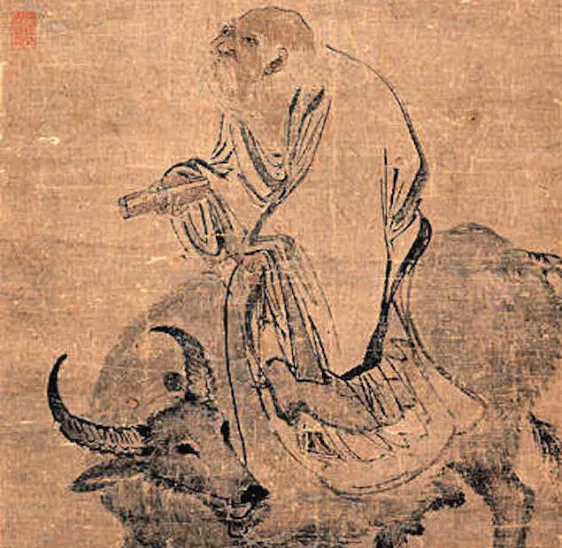
“The Tao that can be spoken is not the true Tao” - Lao Tzu
Aliens in your own mind
Whether psychedelic or phenomenal experiences happen within our own minds or not matters little when you’re in the experience. Like Mankind falling from the cage, we still feel it.
But if our mind is capable of such profound unveilings, then it is far more powerful than we can understand. The truth, the true reality, is more strange and all-encompassing than any thought system can possibly try to capture.
It is unavoidable that to understand disclosure, you must consider the nature of death and dying, the impermanence of all things, and the transmigration of the causes and conditions that ushered in your birth and that will persist beyond your death.
To receive the truth, to achieve gnosis, to know these alien creatures, is to truly understand what a Buddhist means when they say all phenomena are empty.
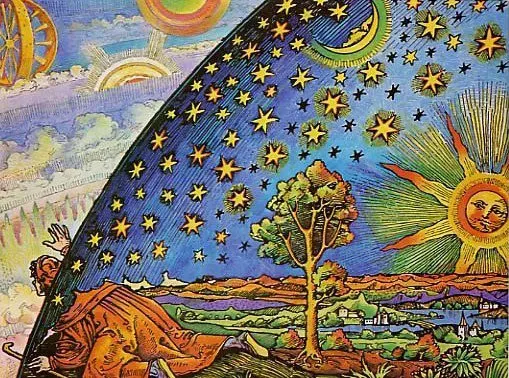
Gnosis is the recognition that frees you from the story you’ve mistaken for reality.
It is not emptiness as an absence of something. It is the absence of true suchness to any phenomenon, a fundamental inability to separate the “reality” of one thing from an impossible infinite whole, which in sum nullifies into endless potential. It is finding an alien and realizing there’s an alien behind that alien and that it’s aliens all the way down.
We are containers for a small spark of this void, unfathomably alive and vast. Once you take that leap, disclosure is a relative, insignificant truth. And you and every being involved already know that.
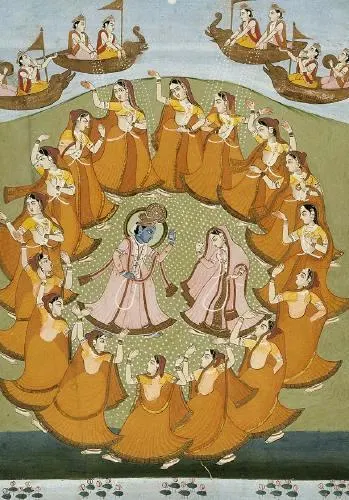
As the Hindus will tell you, life is a divine play: the Rāsa Līlā.